


"An investment operation is one which, upon thorough analysis, promises safety of principal and an adequate return.' This was how Benjamin Graham defined 'investment'. There are three important aspects here,
1. Thorough analysis What is the premise of a buy or a sell decision?
2. Safety of principal Is the premise strong enough? What is the downside before the upside?
3. Adequate return Is the investment going to meet my future financial needs?
Therefore, for an investment operation to be successful, all the three aforesaid factors have to go hand-in-hand to profit from the same. Now, how easy or difficult is that? It has always been a challenge for investors, be it big or small, to ascertain when to buy? and when to sell? Here is an attempt to simplify this process. Remember, we are just trying to simplify the understanding of this process. It is by no means a fool proof guide to easy investing.
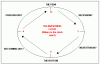
Before going any further, consider the chart above. Imagine the stock market or an economy or a sector as a Clock. The decision of when to buy and when to sell would be a lot simpler if one understands
1. The fact of cycles and
2. Identifies what kind of investor he/she is
A. The fact of cycles
1. 6 to 9 Typically in a cycle, there are peaks, recessions, troughs and again recovery. To make it simpler, when households consume more cooking oil, manufacturers like Marico increase prices of cooking oil.
2. 9 to 12 When Marico earns higher revenues from rising sales, the company generates higher cash flows. To meet the growing demand, the company starts to increase capacity. When Hindustan Lever spots that Marico is making higher profits from the sale of cooking oil, HLL will ramp up capacity and so will a number of other competitors.
3. 12 to 3 When demand fails to meet expectations of Marico, HLL and others (capacity more than demand), prices are cut to boost sales. Therefore, companies make lesser money from higher quantity.
4. 3 to 6 When prices starts tumbling at a faster rate combined with further weakness in demand, manufacturers who are unable to withstand such trend are likely to perish while bigger players make even lesser money. When demand gains momentum, the cycle is kick started again.
Let us clarify that the above is merely an example to illustrate our point.
B. Identify who you are?
There are two broader classes of investors viz. Value Investors and Growth Investors. The buying and selling strategies of both of them is mapped in the table below with respect to the Investment Clock.
Who are you?
Type/characteristics - Value investor - Growth Investor
By nature, he is - Conservative - Aggressive
Bullish - Between 3 to 6, so an early entrant - Between 6 to 9, when the story is visible
Bearish - Between 9 to 12, an early seller - Between 12 to 3, when the story begins to peter off
When does he buy? - Before 6, when no one is buying - After 6, when the momentum is starting
When does he sell? - After 9, when everyone is buying - After 12, a late seller
A stock is a buy, - when the price is below the intrinsic value - there are clear signs of turnaround
A stock is a sell, - when it is nearing target price - it has reached target price
It is pertinent that an investor follows a discipline: either growth or value, irrespective of what is the trend in the stock market. As Mr. Ajit Dayal, Deputy CIO, Hansberger Global Investors puts it During bull markets, the philosophy that we practice at Hansberger Global Investors, the value principles, actually lag market performance because while stock markets are going up, we are typically selling shares because the valuation the market is awarding, we believe and hopefully correctly, is not in tune with the underlying value of the company we are buying. So, the risk of being a value investor with a discipline is that while you are following and implementing that discipline, you actually look stupid and silly, as the statistics look bad when compared to the peer group. But over the longer period of time, we would be right
So whats the message?
What becomes clear from the above deliberations is that you have to clearly identify which strategy appeals to you the most. Whether you are a value investor, who more or less goes against the herd mentality - that is when the bulk of investors are bearish, you analyse the potential and the risk reward ratio, buy into sectors that you think will turnaround and then wait for the turnaround. Or, you may sell when market participants are in frenzy and believe that the golden period is not everlasting.
The premise of this strategy is more tuned towards keeping your risks at bay and the stocks intrinsic value. The pitfall is that it is very difficult to follow this discipline, as you need nerves of steel to swim against the tide. Also, if you Buy into a particular sector/stock with a view that it will turnaround in six months, but it takes 2 years to turnaround, you need to have the patience and the resources to wait it out. Easier said than done!
Or are you a Growth investor? Meaning you follow the tide and buy into known strengths and sell into known weaknesses. The positive here is that you do not have to deal with unknowns. However, the downside is that if you buy in when everybody else is buying you run the risk of paying higher and you may not be able to sell out in time, as everybody else will be doing the same.
Identify yourself, your riskreturn attributes, your discipline and investment time horizon before taking investment decisions. It may be worth your while! As Mahatma Gandhi once said The shortcut to a destination is a straight line. The same applies to the stock market as well.
cheers,
nkpanjiyar
1. Thorough analysis What is the premise of a buy or a sell decision?
2. Safety of principal Is the premise strong enough? What is the downside before the upside?
3. Adequate return Is the investment going to meet my future financial needs?
Therefore, for an investment operation to be successful, all the three aforesaid factors have to go hand-in-hand to profit from the same. Now, how easy or difficult is that? It has always been a challenge for investors, be it big or small, to ascertain when to buy? and when to sell? Here is an attempt to simplify this process. Remember, we are just trying to simplify the understanding of this process. It is by no means a fool proof guide to easy investing.
Before going any further, consider the chart above. Imagine the stock market or an economy or a sector as a Clock. The decision of when to buy and when to sell would be a lot simpler if one understands
1. The fact of cycles and
2. Identifies what kind of investor he/she is
A. The fact of cycles
1. 6 to 9 Typically in a cycle, there are peaks, recessions, troughs and again recovery. To make it simpler, when households consume more cooking oil, manufacturers like Marico increase prices of cooking oil.
2. 9 to 12 When Marico earns higher revenues from rising sales, the company generates higher cash flows. To meet the growing demand, the company starts to increase capacity. When Hindustan Lever spots that Marico is making higher profits from the sale of cooking oil, HLL will ramp up capacity and so will a number of other competitors.
3. 12 to 3 When demand fails to meet expectations of Marico, HLL and others (capacity more than demand), prices are cut to boost sales. Therefore, companies make lesser money from higher quantity.
4. 3 to 6 When prices starts tumbling at a faster rate combined with further weakness in demand, manufacturers who are unable to withstand such trend are likely to perish while bigger players make even lesser money. When demand gains momentum, the cycle is kick started again.
Let us clarify that the above is merely an example to illustrate our point.
B. Identify who you are?
There are two broader classes of investors viz. Value Investors and Growth Investors. The buying and selling strategies of both of them is mapped in the table below with respect to the Investment Clock.
Who are you?
Type/characteristics - Value investor - Growth Investor
By nature, he is - Conservative - Aggressive
Bullish - Between 3 to 6, so an early entrant - Between 6 to 9, when the story is visible
Bearish - Between 9 to 12, an early seller - Between 12 to 3, when the story begins to peter off
When does he buy? - Before 6, when no one is buying - After 6, when the momentum is starting
When does he sell? - After 9, when everyone is buying - After 12, a late seller
A stock is a buy, - when the price is below the intrinsic value - there are clear signs of turnaround
A stock is a sell, - when it is nearing target price - it has reached target price
It is pertinent that an investor follows a discipline: either growth or value, irrespective of what is the trend in the stock market. As Mr. Ajit Dayal, Deputy CIO, Hansberger Global Investors puts it During bull markets, the philosophy that we practice at Hansberger Global Investors, the value principles, actually lag market performance because while stock markets are going up, we are typically selling shares because the valuation the market is awarding, we believe and hopefully correctly, is not in tune with the underlying value of the company we are buying. So, the risk of being a value investor with a discipline is that while you are following and implementing that discipline, you actually look stupid and silly, as the statistics look bad when compared to the peer group. But over the longer period of time, we would be right
So whats the message?
What becomes clear from the above deliberations is that you have to clearly identify which strategy appeals to you the most. Whether you are a value investor, who more or less goes against the herd mentality - that is when the bulk of investors are bearish, you analyse the potential and the risk reward ratio, buy into sectors that you think will turnaround and then wait for the turnaround. Or, you may sell when market participants are in frenzy and believe that the golden period is not everlasting.
The premise of this strategy is more tuned towards keeping your risks at bay and the stocks intrinsic value. The pitfall is that it is very difficult to follow this discipline, as you need nerves of steel to swim against the tide. Also, if you Buy into a particular sector/stock with a view that it will turnaround in six months, but it takes 2 years to turnaround, you need to have the patience and the resources to wait it out. Easier said than done!
Or are you a Growth investor? Meaning you follow the tide and buy into known strengths and sell into known weaknesses. The positive here is that you do not have to deal with unknowns. However, the downside is that if you buy in when everybody else is buying you run the risk of paying higher and you may not be able to sell out in time, as everybody else will be doing the same.
Identify yourself, your riskreturn attributes, your discipline and investment time horizon before taking investment decisions. It may be worth your while! As Mahatma Gandhi once said The shortcut to a destination is a straight line. The same applies to the stock market as well.
cheers,
nkpanjiyar
Attachments
-
 5 KB Views: 105
